Local perspective
Brampton industrial real estate
Space for warehousing, logistics, and production businesses.
Production & distribution
Understand the area before choosing the address.
Brampton occupies the northern half of Peel Region and is one of the largest industrial markets in Canada by floor area. Its advantage is a combination that few municipalities hold at once: Highway 410 and Highway 407 crossing the city, Highway 427 and Highway 401 on its edges, Toronto Pearson minutes to the south, and CN’s Brampton Intermodal Terminal inside the city.
The city’s economic development material highlights advanced manufacturing and food processing, and both are visible on the ground. Brampton holds large production plants, food and beverage facilities, automotive suppliers and a very large base of distribution buildings, which is why a property brief here has to distinguish the infrastructure a production line needs from the layout a storage operation needs.
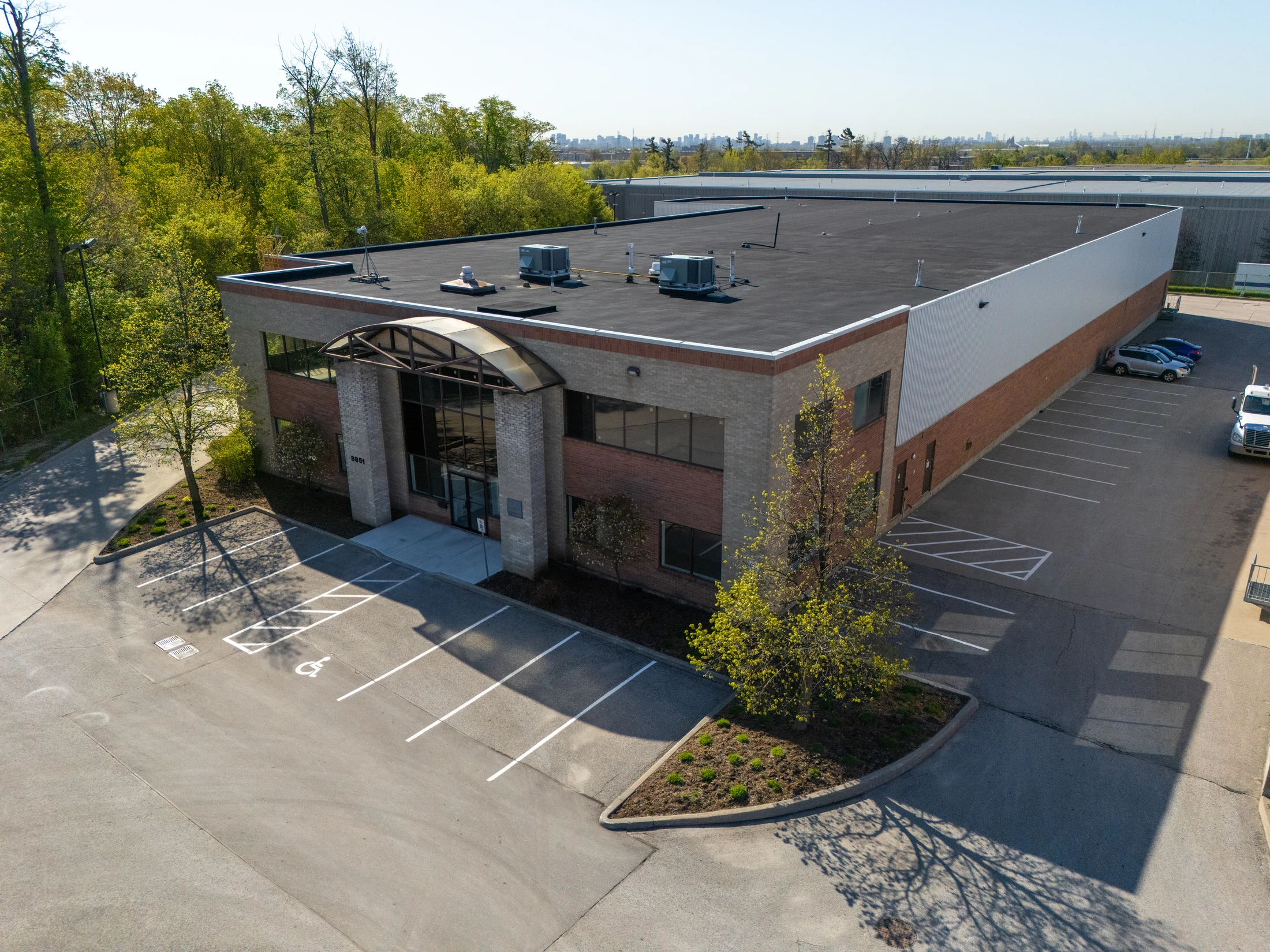
Brampton also sits in the middle of the region rather than at its edge. Joe’s note on the freestanding building he leased at 8 Abacus Road in Bram East made the point directly: the building’s appeal was its central position between Toronto, Mississauga and Vaughan, reached without crossing the city.
Industrial areas in Brampton
Bramalea
The established employment area around Steeles Avenue, Dixie Road, Torbram Road and Highway 410 holds much of Brampton’s manufacturing base, including plants built from the 1960s onward. Sites are larger than in Toronto, power service is often heavier, and the district suits production and assembly rather than high-cube storage.
The Airport Road corridor
Running north from Pearson along Airport Road to Steeles Avenue and beyond, this corridor is the city’s logistics spine. It holds distribution buildings, freight operations and CN’s Brampton Intermodal Terminal on Intermodal Drive, and it is the first place to look for a business built around container flow.
Bram East
The southeast corner of the city, between Highway 427, Queen Street East and the Vaughan boundary, is newer and more distribution-oriented. Its value to an occupier is positional: it reaches Toronto, Vaughan and Mississauga without crossing Brampton, which matters for multi-stop routes.
Bram West
The lands around Mississauga Road, Steeles Avenue and Highway 407 in the southwest hold newer large-bay buildings and a growing base of logistics and distribution users, with quick access to Highway 401 through Mississauga and to Milton.
The Highway 410 north end
Employment lands near Bovaird Drive and Sandalwood Parkway serve businesses that draw labour from Brampton’s northern neighbourhoods and want highway access without the congestion of the Airport Road corridor.
Getting goods in and out
- Highway 410 runs north to south through the city and connects to Highway 401 in Mississauga.
- Highway 407 crosses the south end; Highway 427 serves the eastern edge toward Vaughan and Woodbridge.
- CN’s Brampton Intermodal Terminal is the largest intermodal facility in the GTA and sits on Intermodal Drive off Airport Road.
- Toronto Pearson International Airport is a short drive south on Airport Road or Highway 410.
- Queen Street, Steeles Avenue and Bovaird Drive carry the local truck traffic between districts.
- GO Transit’s Kitchener line stops at Bramalea, Brampton and Mount Pleasant for staff travel.
Building stock and the businesses here
Brampton spans the full range from 1960s and 1970s manufacturing plants in Bramalea to recent large-bay distribution buildings with 36 foot and higher clear heights along Highway 407 and Airport Road. Owner-occupied production facilities, food and beverage plants, automotive and parts suppliers, packaging and plastics operations, and national distribution centres all sit inside the same city, which is why the same advertised square footage can mean very different buildings here. Small-bay multi-unit stock is thinner than in Mississauga or Toronto.
What occupiers weigh in Brampton
- Rail-served and rail-adjacent sites carry truck queuing that affects neighbouring properties near the intermodal terminal. Check the approach at peak times.
- Power and floor loading decide manufacturing fit. Confirm the service at the building, not the street, before a tour progresses.
- Outside storage and trailer parking are zoning questions in Brampton as elsewhere in Peel. Confirm what is permitted on the specific site.
- The labour pool is large and local, and transit access along Steeles, Queen and Airport Road can widen the hiring range for shift work.
- Peak congestion on Steeles Avenue and Airport Road is significant. A site that works for a 10am dispatch may not work for a 7am one.
Framing a Brampton search
Brampton’s economic development material highlights advanced manufacturing and food processing. A property brief should distinguish the infrastructure needed by production from the layout needed by storage.
Local reference: Municipal business and employment-area information.
A Brampton search for a growing operation should start with the busiest shift. Identify the number of employees, incoming loads, and outbound movements at that point. Compare parking, loading, and internal staging against that peak rather than a quiet tour. If production and distribution share the building, map how the two activities interact.
Plan for the change in your operation
Expansion can mean more inventory, another production line, or more shifts. Those changes do not all require the same property solution. Describe which change is driving the move, then test power, floor layout, parking, and loading against it. This makes growth capacity a practical requirement rather than a marketing phrase.
Questions to bring to a Brampton location review
- Is the move driven by storage, production, or dispatch capacity?
- What happens when a shift change overlaps with incoming deliveries?
- Which equipment and utility details must be reviewed before a tour progresses?
Joe’s writing on Brampton
- LEASED - 8 Abacus Rd, Brampton
- FOR LEASE: Highly Functional 65k SF Industrial Warehouse Building in Strategic South Brampton Location
Connect the location decision to the property search.
Once the search area is clear, use a consistent brief to compare individual facilities. Joe can organize the search around leasing, purchasing, or a stay-versus-move decision. That keeps the reason for choosing Brampton connected to the actual spaces being considered.
For building criteria, search options, and the information to request on a tour, continue to the dedicated Brampton industrial property search guide.
Comparing locations
A clearer local brief.
Which areas should I compare with Brampton?+
Consider Mississauga, Vaughan, Milton where they fit the same operating requirements. These are geographic search connections, not a claim that the markets have identical buildings, costs, or availability.
Does a location guide confirm a property is suitable for my business?+
No. The guide helps structure a location decision. The actual site, building, intended activity, and proposed changes need their own review.
Where should I start if I am still choosing a location?+
List the daily journeys made by your staff, deliveries, and customers. Add the building essentials and timing in the property brief. Joe can then help identify areas worth comparing.
Your next move
Let’s talk
about what’s next.
A new facility. A better lease. A different direction.
Start with a conversation about your business.