Local perspective
Etobicoke industrial real estate
An established Toronto industrial search area.
Toronto’s western submarket
Understand the area before choosing the address.
Etobicoke is Toronto’s western industrial half and the part of the city that behaves most like a modern distribution market. Its northwest corner, West Humber-Clairville, is the largest employment area in Toronto, bounded by Highways 427, 409 and 401 and sitting directly against Toronto Pearson International Airport.
That position is the reason occupiers pay for it. Joe represented an air filter distribution company on a lease at 96 Carrier Drive in West Humber-Clairville, where the deciding factor was immediate proximity to Highway 27 and the 400 series network for a business built around timely product distribution. Freight forwarding, food distribution, building products and printing all cluster here for the same reason.
South Etobicoke is a different market entirely. The band of older industry along The Queensway, Horner Avenue and Evans Avenue holds smaller units and lower buildings, parts of it have been redeveloped for housing, and it serves service businesses and light manufacturers that need to sit close to the city rather than close to the airport.
Industrial areas in Etobicoke
West Humber-Clairville and Rexdale
Toronto’s largest employment area runs from Highway 401 north to Steeles Avenue between Highway 427 and the Humber River. Carrier Drive, Attwell Drive, Belfield Road, Disco Road and Highway 27 carry freight forwarders, distributors, food businesses and printers, and this is where the district’s better loading and newer buildings are found.
The Highway 427 and Dixon Road airport edge
The strip closest to Pearson, around Dixon Road, Carlingview Drive and Attwell Drive, is dominated by air cargo related businesses, freight handling and hotels. Truck access is excellent and site sizes are small, so yard space is the usual constraint.
South Etobicoke
Along The Queensway, Horner Avenue, Evans Avenue and Browns Line, the buildings date largely from the 1950s to the 1970s. Units are smaller with lower clear heights, and redevelopment has replaced some blocks with housing, so planning status and long-term ownership intentions matter here.
The Kipling and Islington corridor
Between the two, the industrial pockets near Kipling Avenue and Islington Avenue hold service industrial and light manufacturing buildings, with good access to both the Gardiner Expressway and Highway 401 and proximity to TTC Line 2 for staff.
Getting goods in and out
- Highway 427 runs north to south through the district, with Highway 409 connecting directly into the airport and Highway 401 crossing at the top.
- Toronto Pearson International Airport is immediately west, with cargo facilities a few minutes from most Rexdale addresses.
- The Gardiner Expressway and the QEW serve south Etobicoke and connect to Mississauga and the lakeshore.
- Highway 27, Dixon Road, Kipling Avenue and Islington Avenue carry local truck movements.
- GO Transit’s Kitchener line stops at Etobicoke North and Malton; the Lakeshore West line stops at Mimico and Long Branch.
- TTC Line 2 terminates at Kipling, and surface routes serve both Rexdale and the southern employment areas.
Building stock and the businesses here
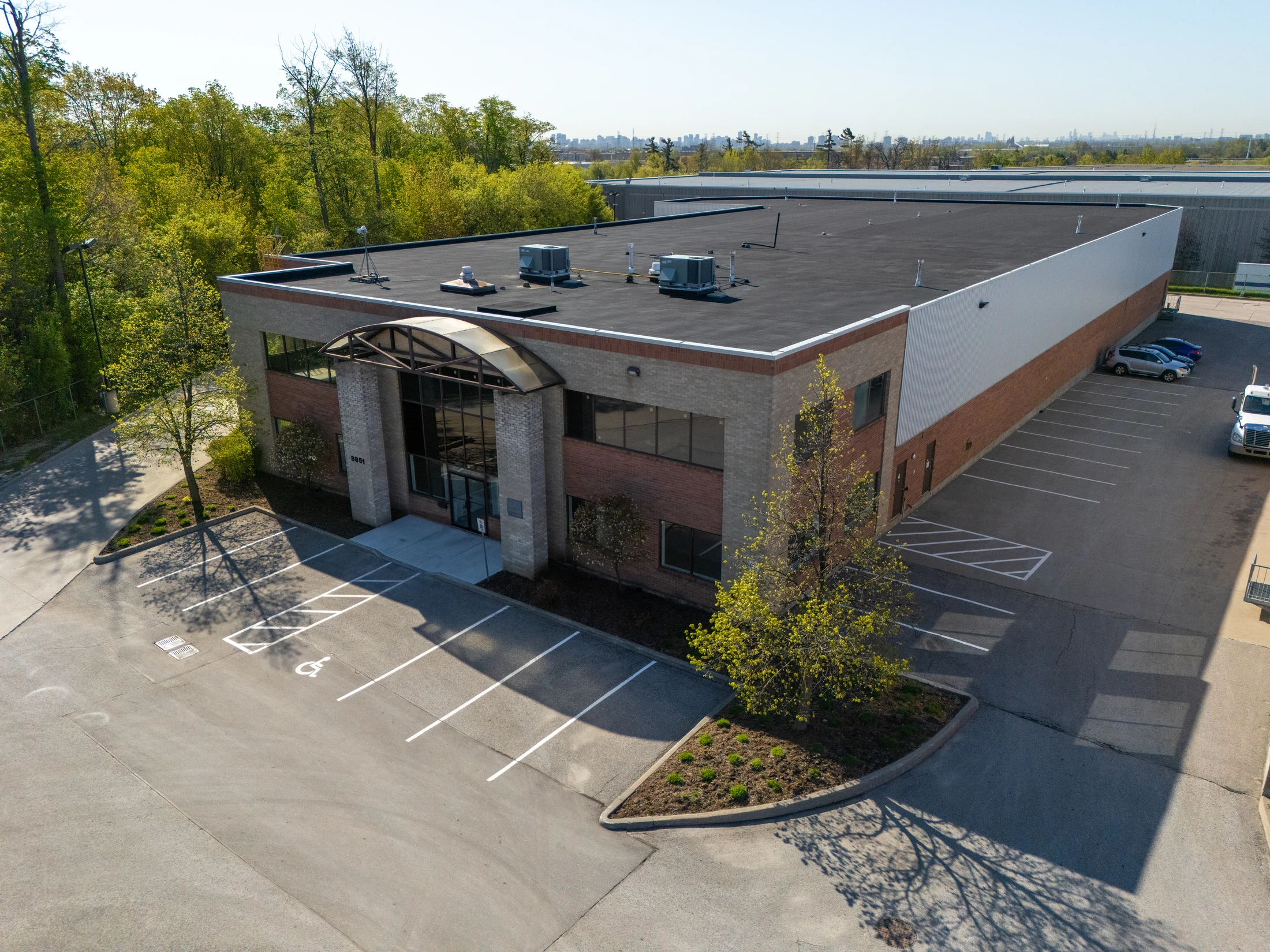
Etobicoke’s northwest holds Toronto’s best concentration of functional industrial buildings: 1970s to 1990s freestanding and multi-unit properties with truck-level loading, plus newer product near Highway 427. Clear heights are generally better than elsewhere in the city, though truck courts are still shallower than in Peel or Halton. South Etobicoke is older and smaller in format. Occupiers include freight forwarders and customs brokers, food importers and distributors, printers and packaging businesses, building products suppliers, mechanical and electrical contractors, and a wide base of small service industrial operations.
What occupiers weigh in Etobicoke
- Multi-unit sites share circulation and loading. Establish how vehicles approach the door, where deliveries wait and which areas are genuinely exclusive to the unit.
- Airport operations bring noise, height restrictions and overnight activity to the Rexdale area. They suit some uses and rule out others.
- South Etobicoke has lost industrial land to residential redevelopment. Confirm the designation and the landlord’s plans before a long lease.
- Truck routes and the Humber River crossings shape the real approach to many Rexdale sites, so check the route rather than the distance.
- Mississauga’s airport and northeast submarkets serve many of the same customer routes and belong in the same comparison.
Framing a Etobicoke search
Toronto’s employment-area resources identify Rexdale-Airport and South Etobicoke as distinct employment areas. Etobicoke is part of Toronto, with a western location that can be compared with Mississauga.
Local reference: Municipal business and employment-area information.
An Etobicoke search should distinguish the part of the district that fits your customers and staff. A broad west-Toronto address preference is less useful than a clear set of daily routes. Assess the street approach, loading space, and internal layout together, especially where more than one business uses the same site.
Inspect shared space as part of the premises
In a multi-occupant property, circulation and loading arrangements can be as important as the unit itself. Establish how vehicles approach the doors, where deliveries wait, and which areas are shared. Record questions for the property representative instead of assuming that an empty area seen during a tour is available for exclusive use.
Questions to bring to a Etobicoke location review
- Does the business need northern or southern Etobicoke access?
- Which loading and circulation areas are shared with other occupants?
- Would a Mississauga option serve the same customer routes?
Joe’s writing on Etobicoke
Connect the location decision to the property search.
Once the search area is clear, use a consistent brief to compare individual facilities. Joe can organize the search around leasing, purchasing, or a stay-versus-move decision. That keeps the reason for choosing Etobicoke connected to the actual spaces being considered.
For building criteria, search options, and the information to request on a tour, continue to the dedicated Etobicoke industrial property search guide.
Comparing locations
A clearer local brief.
Which areas should I compare with Etobicoke?+
Consider Mississauga, North York, Toronto where they fit the same operating requirements. These are geographic search connections, not a claim that the markets have identical buildings, costs, or availability.
Does a location guide confirm a property is suitable for my business?+
No. The guide helps structure a location decision. The actual site, building, intended activity, and proposed changes need their own review.
Where should I start if I am still choosing a location?+
List the daily journeys made by your staff, deliveries, and customers. Add the building essentials and timing in the property brief. Joe can then help identify areas worth comparing.
Your next move
Let’s talk
about what’s next.
A new facility. A better lease. A different direction.
Start with a conversation about your business.