Local perspective
Toronto industrial real estate
A central base for urban distribution and established industrial operations.
City-wide search
Understand the area before choosing the address.
Toronto is where the region’s customers are, and its industrial land was laid out long before the trucks that serve them. The city’s employment areas fall into three broad groups: the western lands around Toronto Pearson International Airport and Highway 427, the northern lands around Downsview and Highway 400, and the eastern lands strung along Highway 401 through Scarborough and down to the Port Lands. Each group serves a different delivery geography, so a city-wide search is really a choice between three or four submarkets rather than one market.
Occupiers choose Toronto for proximity and for labour. A facility inside the city can hold same-day and next-morning delivery windows that are difficult to keep from Milton or Bradford, and it can draw staff who travel by TTC rather than by car. The trade-off is physical. Sites are small, truck courts are shallow, and the building available inside the city is usually older and lower than the one the same budget would secure on the edge of the region.
Joe has written about what separates two Toronto warehouses of the same size and asking rate, and his answer is function rather than address. Loading ratio, shipping court depth, clear height, power and office content decide whether the operation fits, and the submarket follows from the operating model rather than the other way around.
Industrial areas in Toronto
Rexdale and West Humber-Clairville
Toronto’s largest concentration of industrial land sits in northwest Etobicoke, bounded by Highways 427, 409 and 401 and running north to Steeles Avenue. Streets such as Carrier Drive, Attwell Drive, Belfield Road and Disco Road hold freight forwarders, food distributors, printers and building-products suppliers that depend on being minutes from airport cargo. It is the part of Toronto where a modern truck court and a deep loading bay are most likely to be found.
South Etobicoke
The Queensway, Horner Avenue, Evans Avenue and Browns Line carry an older band of manufacturing and service industry between the Gardiner Expressway and Lake Ontario. Units are smaller, clear heights are modest, and several blocks have been redeveloped for housing, so confirm the planning status of the site as well as the condition of the building.
Downsview and Keele-Finch
North York’s employment areas sit on either side of Highway 400 and Keele Street, with Downsview at the centre. Buildings are typically 1960s and 1970s multi-unit properties on small sites, suited to contractors, mechanical trades, printers and production services that need to be central. The former Downsview airport lands beside them are the subject of a long-term redevelopment plan worth understanding before signing a long lease nearby.
Tapscott, Milliken and the Highway 401 corridor in Scarborough
East Toronto’s industrial land runs from Steeles Avenue at Tapscott and Milliken south through Progress Avenue, Markham Road and McCowan Road to Highway 401. Food processing and distribution, auto parts, plastics and printing are all well represented, and CPKC’s Toronto Yard at Agincourt puts an intermodal terminal inside the city limits.
The Port Lands and the eastern waterfront
Commissioners Street, Unwin Avenue and the surrounding port district hold aggregate handling, film studios, waste and recycling operations and the Port of Toronto’s marine terminals. It is a specialized district rather than a general warehouse market, and much of it is tied up in flood-protection and waterfront redevelopment work.
Getting goods in and out
- Highway 401 crosses the city from Etobicoke to Scarborough and is the spine of almost every Toronto distribution route.
- Highways 400, 404, 427 and 409 feed the 401 and connect the city to Vaughan, Markham, Mississauga and the airport.
- The Gardiner Expressway and Don Valley Parkway serve the downtown and waterfront, where congestion matters more than distance.
- Toronto Pearson International Airport sits immediately west of the city boundary, reached from Highway 427 and Dixon Road.
- CPKC’s Toronto Yard in Agincourt is inside the city; CN’s MacMillan Yard is just north of it in Vaughan.
- The Port of Toronto operates marine terminals in the Port Lands.
- TTC subway and surface routes, together with GO rail, give a Toronto facility a labour catchment a car-dependent location cannot match.
Building stock and the businesses here
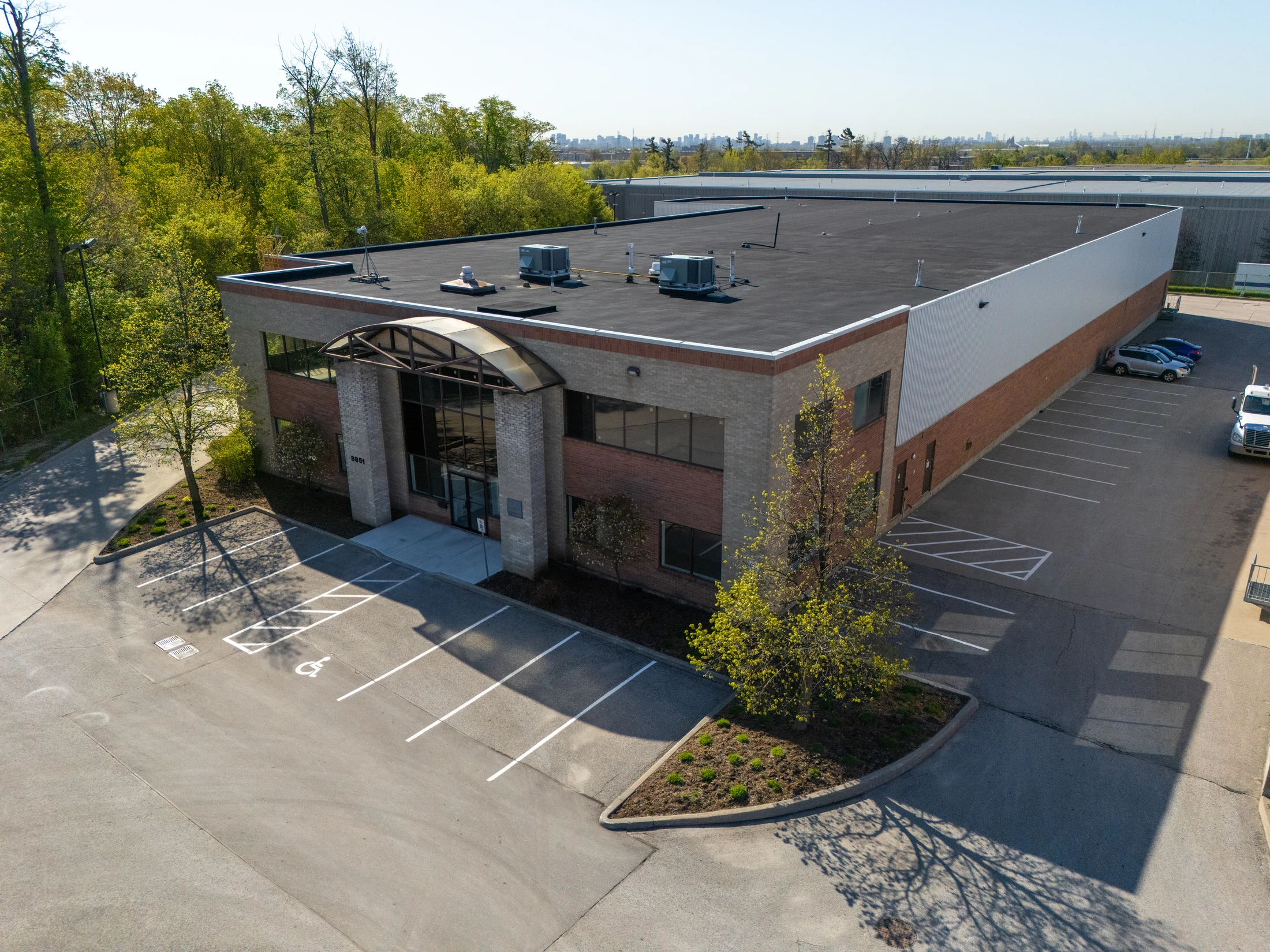
Most Toronto industrial buildings date from the 1950s to the 1980s: multi-unit blocks and freestanding plants on tight sites, commonly in the 14 to 22 foot clear range, with shallow truck courts and little trailer parking. Newer product is concentrated in Rexdale and along Highway 401. The occupiers reflect that stock rather than fight it. Urban distribution and last-mile operators, food producers and importers, printers, building-products suppliers, mechanical and electrical trades, film and studio services, and small manufacturers that value being close to their customers more than they value clear height.
What occupiers weigh in Toronto
- Truck routes and residential neighbours. Many Toronto employment areas abut housing, and the approach to the door can be governed by municipal truck routes rather than the shortest line on a map.
- Employment land conversion. The Official Plan protects designated employment areas, but pockets in south Etobicoke, the Golden Mile and along Eglinton are being redeveloped. Confirm the designation before committing to a long term.
- Parking is usually the first constraint. Older sites were built for fewer staff and smaller vehicles, so employee parking, van fleets and trailer storage compete for the same asphalt.
- Power and sprinkler capacity in older buildings. Upgrades inside the city can be slow and costly, so verify what the process needs early.
- Labour reached by transit. A site within walking distance of a frequent TTC route widens the hiring pool, which can outweigh a longer truck trip.
Framing a Toronto search
Toronto spans distinct employment areas, including Rexdale-Airport, South Etobicoke, Downsview, and Tapscott. A city-wide search is most useful when those submarkets are compared separately.
Local reference: Municipal business and employment-area information.
Build the search around delivery destinations. A business supplying central Toronto may evaluate locations differently from one serving regional customers. Identify the delivery windows, vehicle types, and return trips that generate the most operational pressure. Then compare a western, northern, and eastern shortlist using the same assumptions.
Choose a Toronto submarket before comparing buildings
For a city-wide requirement, decide whether proximity to customers outweighs the need for a different loading layout or a larger footprint. Tour one credible option in each suitable district before committing to a narrow search. Record the compromises explicitly so an attractive address does not overshadow the way the facility will work.
Questions to bring to a Toronto location review
- Which Toronto district serves the greatest share of daily deliveries?
- Can incoming trucks and outbound vehicles use the site at the same time?
- How much office space is genuinely needed alongside storage or production?
Joe’s writing on Toronto
- Warehouses for Lease in Toronto: What Matters
- Why is Demand for Industrial Real Estate Rising in Toronto?
Connect the location decision to the property search.
Once the search area is clear, use a consistent brief to compare individual facilities. Joe can organize the search around leasing, purchasing, or a stay-versus-move decision. That keeps the reason for choosing Toronto connected to the actual spaces being considered.
For building criteria, search options, and the information to request on a tour, continue to the dedicated Toronto industrial property search guide.
Comparing locations
A clearer local brief.
Which areas should I compare with Toronto?+
Consider Etobicoke, North York, Scarborough where they fit the same operating requirements. These are geographic search connections, not a claim that the markets have identical buildings, costs, or availability.
Does a location guide confirm a property is suitable for my business?+
No. The guide helps structure a location decision. The actual site, building, intended activity, and proposed changes need their own review.
Where should I start if I am still choosing a location?+
List the daily journeys made by your staff, deliveries, and customers. Add the building essentials and timing in the property brief. Joe can then help identify areas worth comparing.
Your next move
Let’s talk
about what’s next.
A new facility. A better lease. A different direction.
Start with a conversation about your business.