Local perspective
North York industrial real estate
Industrial space within Toronto’s northern business areas.
Toronto’s northern submarket
Understand the area before choosing the address.
North York is Toronto’s northern band, running from the Humber River to the Don Valley along Highway 401 and Steeles Avenue. Its employment areas were built between the 1950s and the 1970s for businesses serving the city, and that is still what most of them do: contractors, service industrial operations, printers, food businesses and light manufacturers that need to be central rather than close to a port or a border.
The district’s advantage is position. A North York facility sits inside the city, at the junction of Highway 401 with Highways 400 and 404, minutes from both Vaughan and midtown Toronto, and within reach of the TTC network. Its disadvantage is physical: small sites, modest clear heights, limited truck courts and very little land for expansion.
That makes North York a market where workflow matters more than floor area. A compact building works well when its layout matches the operation and becomes restrictive quickly when storage, production and staff circulation compete for the same space.
Industrial areas in North York
Downsview
The employment lands around Sheppard Avenue West, Keele Street and Chesswood Drive form the largest industrial district in North York, with 1960s and 1970s multi-unit and freestanding buildings occupied by trades, printers, production services and light manufacturers. The former airport lands beside the district are the subject of a long-term redevelopment plan.
Keele-Finch and the Highway 400 lands
Around Finch Avenue West and Highway 400, this area holds the district’s most highway-accessible industrial buildings and its heavier users, with direct connections north to Vaughan and south to Highway 401.
The Steeles Avenue West corridor
Between Keele Street and Dufferin Street, the Steeles corridor faces Vaughan’s Concord district across the municipal boundary and shares much of its character, with multi-unit industrial buildings serving food, furniture, printing and distribution businesses.
The Caledonia and Dufferin rail corridor
South of Highway 401 along Caledonia Road and Dufferin Street, older employment lands follow the rail corridor. Buildings are small and the area is under redevelopment pressure, but it remains useful for service businesses that need to be close to midtown.
Getting goods in and out
- Highway 401 crosses the district, meeting Highway 400 in the west and Highway 404 and the Don Valley Parkway in the east.
- Allen Road connects Highway 401 south toward midtown, and Steeles Avenue runs along the Vaughan boundary.
- Keele Street, Dufferin Street, Sheppard Avenue West and Finch Avenue West carry local truck movements.
- TTC Line 1 runs through the district to Vaughan, and Line 4 serves Sheppard, giving unusually good transit access for industrial areas.
- GO Transit’s Barrie line stops at Downsview Park.
- Toronto Pearson is reached on Highway 401 to Highway 409, and CN’s MacMillan Yard sits just north in Vaughan.
Building stock and the businesses here
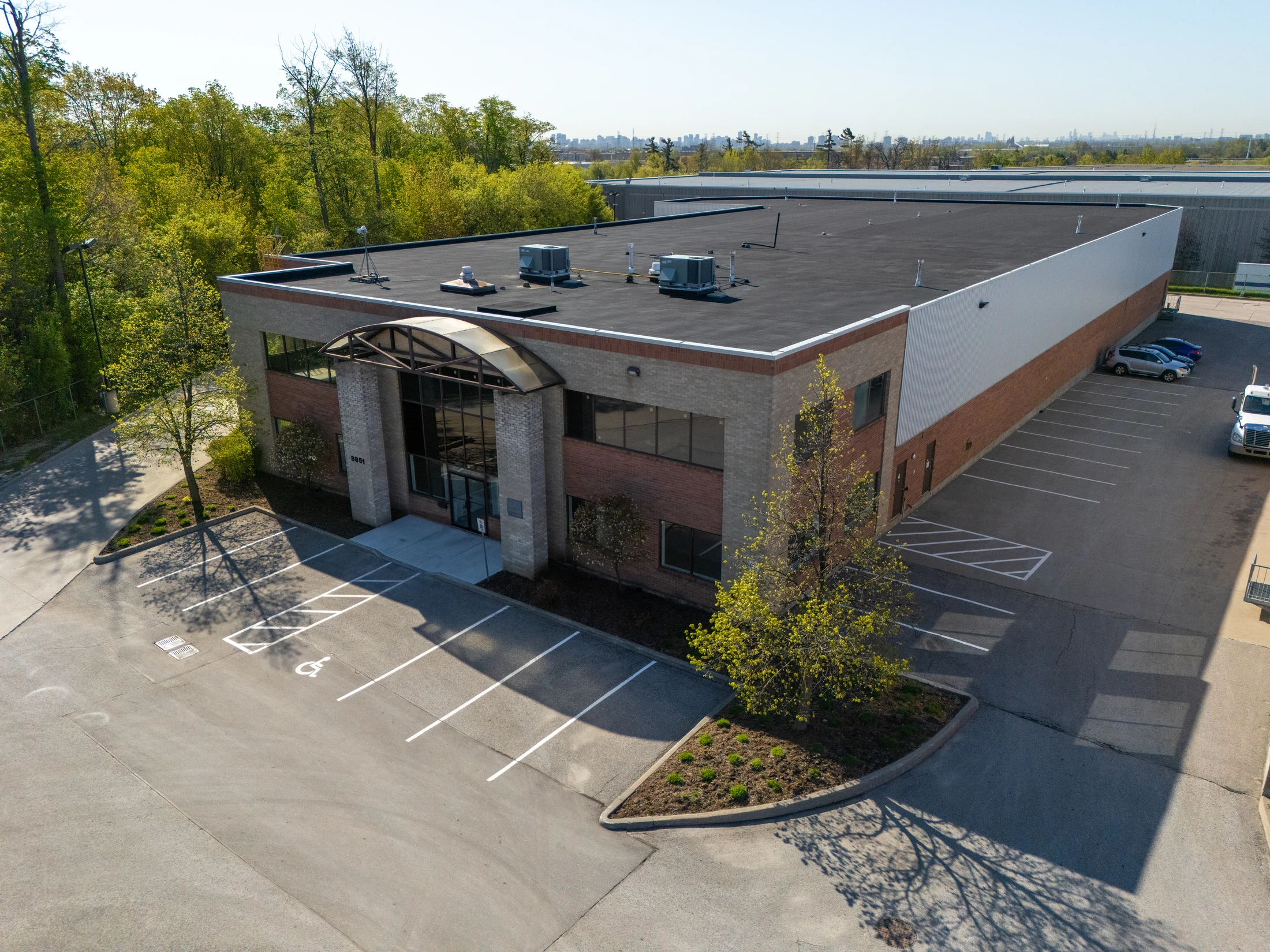
Most North York industrial buildings date from the 1950s to the 1970s: multi-unit blocks, small freestanding plants and service buildings on tight urban sites, with clear heights commonly in the 12 to 18 foot range and drive-in or single truck-level loading. Very little new industrial product has been built here in decades. Occupiers are weighted toward mechanical, electrical and building trades, printing and packaging, food production and distribution, film and production services, automotive service, electronics and small-scale manufacturing.
What occupiers weigh in North York
- Usable workflow matters more than headline area. Walk the whole process on the floor plan and find where a larger delivery or an extra workstation creates the bottleneck.
- Redevelopment is reshaping parts of the district, particularly around the former Downsview airport lands. Understand the planning context before a long lease.
- Truck access often runs through arterials that carry heavy local traffic, and some sites back onto housing.
- Older electrical service can limit equipment. Verify capacity at the building before committing to a process that needs more.
- Vaughan’s Concord district is immediately north with larger sites and higher clear heights, so it belongs in the same comparison.
Framing a North York search
North York is part of Toronto. The City’s employment survey identifies Downsview and Highway 400 among its employment-area clusters, which helps frame a more focused northern Toronto search.
Local reference: Municipal business and employment-area information.
A North York brief should explain why the operation needs to remain within northern Toronto. Staff access, service calls, suppliers, and proximity to an existing facility may all matter. Compare those requirements with Vaughan where the operation can accommodate a wider search, while retaining the same standards for the building itself.
Look for usable workflow within the footprint
A compact facility can work well if its layout matches the operation. It can also become restrictive if storage, packing, and staff circulation compete for the same area. Walk the entire process on a floor plan and identify where a larger delivery or additional workstation would create a bottleneck.
Questions to bring to a North York location review
- Which daily journeys make northern Toronto important?
- Can storage and production expand without occupying circulation space?
- Would a Vaughan location preserve the relationships the business depends on?
Connect the location decision to the property search.
Once the search area is clear, use a consistent brief to compare individual facilities. Joe can organize the search around leasing, purchasing, or a stay-versus-move decision. That keeps the reason for choosing North York connected to the actual spaces being considered.
For building criteria, search options, and the information to request on a tour, continue to the dedicated North York industrial property search guide.
Comparing locations
A clearer local brief.
Which areas should I compare with North York?+
Consider Vaughan, Etobicoke, Scarborough where they fit the same operating requirements. These are geographic search connections, not a claim that the markets have identical buildings, costs, or availability.
Does a location guide confirm a property is suitable for my business?+
No. The guide helps structure a location decision. The actual site, building, intended activity, and proposed changes need their own review.
Where should I start if I am still choosing a location?+
List the daily journeys made by your staff, deliveries, and customers. Add the building essentials and timing in the property brief. Joe can then help identify areas worth comparing.
Your next move
Let’s talk
about what’s next.
A new facility. A better lease. A different direction.
Start with a conversation about your business.